
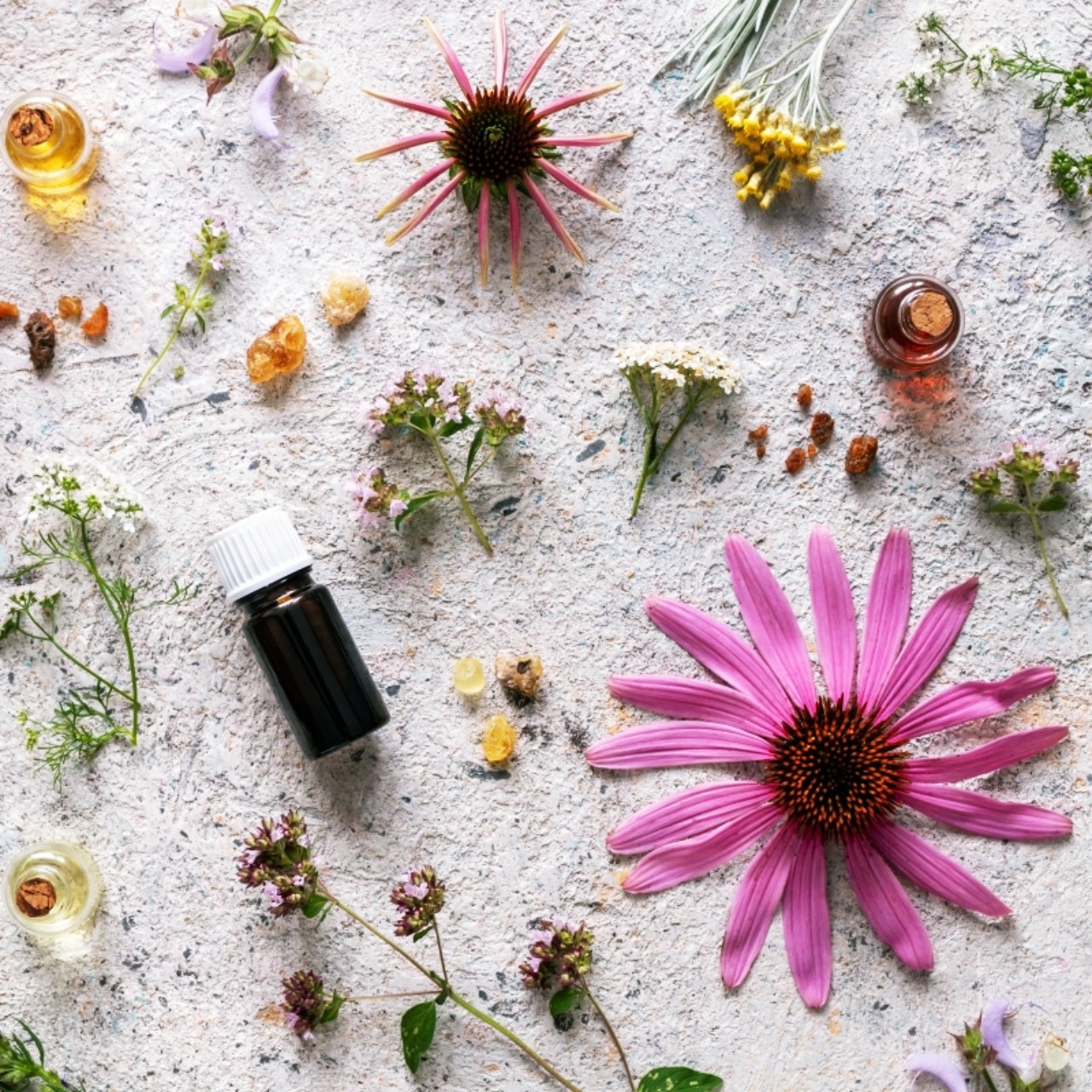
Flower essences are a form of natural wellness practice that works gently with emotional experience, drawing on the subtle qualities associated with plants. In this article, we explore how flower essences may connect mind and body, and what meaning they can hold through a psychological lens.
What Are Flower Essences?
Flower essences have been quietly passed down as a practice for supporting emotional balance. A defining characteristic is that they focus not on material constituents, but on the subtle “quality” or “information” associated with a plant. Rather than aiming to treat the body directly, flower essences are often described as supporting shifts in inner attitude and emotional patterns—creating space where tension in thought and feeling may soften. Through this indirect pathway, a person may experience a broader sense of harmony.
Flower essences became widely systematized in the 1930s through the work of British physician Dr. Edward Bach. He believed that the root of many difficulties lies in “emotional disharmony,” and that healing involves returning to inner alignment. The 38 Bach Flower Remedies are not selected for medical symptoms, but for states of mind and emotion. This approach prioritizes the person’s individuality over diagnostic labels—an orientation that many people find gentle and deeply respectful.
Today, flower essences are used as part of emotional self-care and complementary support in various settings, including wellbeing, education, and supportive care contexts. While scientific evidence for mechanisms remains limited, the practice continues to be quietly sustained by experiential reports of subtle emotional shifts and increased inner steadiness.
For people living with stress, anxiety, or inner pressure, this gentle “tuning” may become a doorway back to oneself— not through a diagnosis, but through listening to what is felt beneath the surface. In that sense, flower essences can be understood as companions in the act of inner attention.
Seeing the Connection Between Emotion and Health
The idea that “the state of the mind is reflected in the state of the body” is no longer considered unusual. Stress, anxiety, anger, and grief can influence the autonomic nervous system and immune function, sometimes appearing as physical discomfort. This perspective is shared not only in psychology, but also in medicine and supportive care.
At the same time, emotions are more than simple “reactions.” They often reflect a person’s values, history, and way of living. That is why turning toward emotion—rather than ignoring it—can become a powerful act of self-understanding.
The role of flower essences may not be to “change emotion directly,” but to create a little more space to feel. As emotional pressure softens, a person may regain stability and a sense of inner regulation. Any resulting benefits for the body are understood here as indirect, not guaranteed, and never as a replacement for medical care. Rather than adding something from outside, the process supports an environment in which one can hear the inner voice more clearly.
Over time, people may notice that emotions become easier to sense and name. Such experiences can strengthen self-regulation and serve as quiet foundations for psychological and physical wellbeing.
Symbol and Archetype in Psychology
When someone feels drawn to a particular flower essence, it may not be random—it can feel like a message from deeper layers of the psyche. Many psychological traditions speak of an inner depth that carries shared human patterns and images. In Jungian terms, this includes the “collective unconscious” and archetypes.
Swiss psychologist Carl Gustav Jung explored how dreams, symbols, and images connect to inner life. These concepts are widely used in depth psychology as frameworks for meaning and insight, though they are difficult to prove empirically and are best understood as interpretive tools. Jung’s work influenced many therapeutic and reflective approaches, and flower essences are sometimes discussed within this symbolic context.
For example, Star of Bethlehem—often associated with shock and deep grief— can be interpreted as resonating with an archetype of “healing.” Mimulus may symbolize courage in facing fear, helping one acknowledge vulnerability without shame. In this view, the emotional themes represented by each essence are not merely mood fluctuations, but connect to deeper, widely shared human patterns.
This symbolic approach does not focus on categorizing symptoms in detail. Instead, it offers a way to read the “map” behind emotion. When a person touches what lies beneath emotion, that encounter may become not only an opportunity for relief, but also for growth and integration.
Ultimately, what flower essences may point toward is not the “power of plants” alone, but a pathway to the strength already present within us. A flower simply exists—quietly—and yet it can open a conversation with the inner world.
Inner States and Choosing Essences
We live within waves of emotion. Sometimes a small event shakes us; sometimes anxiety arrives without clear reason. Flower essences are often chosen to gently accompany these subtle movements, helping one notice what is actually present and what kind of inner support may be needed.
Each essence is traditionally associated with certain emotional or psychological themes. For beginners, this can feel confusing: “Which one should I choose?” However, the process does not need to be complicated. A useful first step is simply to look at what you are feeling right now.
For everyday, specific worries, Mimulus is often selected. The small yellow flower is associated with sensitivity and inner delicacy, and is traditionally used for facing concrete fears.
For vague unease without a clear cause, Aspen may resonate. Aspen leaves tremble in the wind—an image often used to describe anticipatory anxiety and invisible fear.
When confidence is low and taking a step forward feels difficult, Larch is commonly chosen. It is associated with cultivating the inner belief: “I can try.”
During periods of transition, Walnut is frequently used. It symbolizes flexible adaptation and inner stability—supporting a person to move forward without being overly influenced by surrounding pressures.
In this way, flower essences can feel as if they “meet” the subtle shifts of inner life. The encounter is less like choosing a product and more like sensing what kind of energy fits the current emotional season.
The most important point is not to find a single “correct” answer, but to cultivate a quiet attitude of listening. Whatever essence is chosen, the process itself can become time spent respecting, caring for, and re-centering one’s inner voice.
Flower Essences in Contemporary Society
Because scientific and clinical evidence remains limited and individual responses vary, flower essences are not a substitute for mainstream medical care. However, in parts of Europe—such as Germany and Switzerland— they are widely used as complementary emotional support, and in the UK it is not uncommon to see dedicated sections in pharmacies. In Japan, broader adoption has been slower, yet interest continues to grow quietly among those focused on emotional wellbeing and self-care.
This quiet expansion may reflect something about contemporary life: moments when we feel our emotions are left behind, as information and schedules fill every space. In such conditions, many people begin searching for something that can stay close to emotion without forcing it.
Flower essences may be received as gentle companions to these inner gaps. Many people report experiences such as “I felt calmer,” or “my perspective shifted slightly.”
Perhaps they help us remember a sensory connection with nature that modern life often erodes.
From a social psychological perspective, this phenomenon can be seen as reflecting a deep need for self-regulation and meaning-making. Not asking someone else for the answer, but listening inward and re-centering oneself— such actions may function as a form of quiet resilience in unstable times.
Flower essences do not offer a clearly established mechanism like pharmaceuticals, and effects may differ from person to person. Still, it is also true that some people experience soft emotional easing and small shifts in how they meet life. These experiences may carry the anxieties and hopes of our era—quietly visible in the background.
A Future Significance as Natural Wellness
Flower essences continue to spread quietly as a natural wellness approach supporting “whole-person health,” including emotion and thought. Their influence is often subtle—touching inner turbulence and stagnation gently, and inviting a person’s own restorative capacity to re-emerge.
In healthcare and wellbeing fields today, holistic perspectives are increasingly valued—approaches that consider not only symptoms, but the person’s quality of life and way of being. In this sense, the ethos of flower essences resonates with current shifts in care.
By touching the subtle qualities of plants, people may also remember their connection with nature. Essences can accompany the return of sensitivity and rhythm that daily life often pushes aside.
A small glass bottle, carrying the presence of a flower, can create moments that touch something deep. Accumulated over time, such moments may foster gentle change— not only for individuals, but as a softer atmosphere within society. We hold this possibility with quiet hope.
Our Practice and Outlook
At Salon de Alpha, we treat flower essences as a natural wellness practice that supports understanding and regulation of emotion. Our aim is to offer care that holds both professional knowledge and deep respect for sensitivity.
Rather than simply “using” essences, we value the attitude of meeting plants, and the time of quiet inner dialogue itself. Through sessions, education, and writing, we carefully open pathways connecting plant intelligence and the inner world.
Some hypotheses—such as ideas about water carrying information— are sometimes discussed as intriguing possibilities. At present these remain experimental and not scientifically established, yet further research may bring new perspectives in the future. As older forms of wisdom about subtle natural influence are reconsidered today, the value of flower essences may also be illuminated in new ways.
With respect for the “unseen,” we hope to communicate the essential value of flower essences in a form suited to our era—without exaggeration.
Beyond knowledge and theory, what we cherish most is the quiet time of facing oneself.
To pause in daily life, and simply be with a flower for a moment. That small time may gently touch the inner world, becoming a doorway to soft change.
Flowers bloom, and say nothing— yet they touch the heart. Flower essences may be one entrance into that dialogue with nature.
(Editorial review: Salon de Alpha — Natural Wellness Advisor)